Ryan Humphries
It’s no secret that I’m a fan of eyewear. Since having LASIK eye surgery a few years back, my eyes have been extra sensitive and I’m always on the hunt for the right pair of shades to match my outdoor activities. While it’s true that a lot of folks will use the same pair of sunglasses for just about anything they do outside, there are a few activities where I’d recommend you niche down. Climbing a glacier is one of those activities 🙂

Julbo Montebianco 2 Sunglasses Review
In early January of 2024, The Axistence crew, including several Engearment writers, traveled south of the border to climb the 3rd highest peak in North America, Pico De Orizaba (18,491’).
There are three things can lead to one’s success (or failure) on an adventure like this:
- Physical conditioning
- Mental fortitude
3. Gear
Personally I felt pretty good about the first two, but I didn’t want to take any chances with number three.

Julbo heard about our adventure, and they were kind enough to quickly ship a pair of the Montebiancos so we’d have them before the trip.
If you know you’re going to be spending the better part of the day climbing at altitude in the snow and ice, there are few items that are crucial. One of those is eyewear.
If you’ve done any sort of mountaineering, you’ve likely heard the term “Alpine Start”. That’s just a fancy way of saying that you’re waking up at the pre-butt-crack of dawn to make sure you’re on (and off) the mountain early. I mention this because when you wake up at midnight, sunglasses might not be on your radar.

You might forget your snacks. You might forget your hand warmers. You might forget that extra set of moleskin for your blisters. Do NOT forget your eyewear.
Much like a senior on Prom night, you don’t want to be caught without protection when you need it most. Snow blindness is a very real thing. Light is coming from both above, and reflecting off the snow below. Also, fun fact according to the American Academy of Opthamology, when at altitude, UV light penetrates faster due to the thin air (1). So yeah, eyewear isn’t something you want to forget.
Side note, Glacier Glasses are also not something you want to pick up from a street vendor the night before in Mexico City.

While eye protection in general is good, when you’re headed to a glacier, trust me, you want Glacier Glasses.
If you do a quick search for Glacier or Mountaineering Glasses, you’ll see that Julbo is always one of the first results. That’s for good reason. When it comes to protecting the eyeballs of mountaineers, this isn’t their first rodeo.
A little back story, in 1888, the founder (Jules Beaud) was living in the Jura mountains in France. Those mountains are known for two things, awesome skiing and crystals. There were crystal hunters in the area who, in order to uncover their treasures, had to mountaineer their way into the backcountry. Where most people were just trying to get up and down the mountains, these folks were spending days out there….and they needed to be able to see what the hell they were doing. To help these folks out, Jules created a pair of glasses specifically for them and he called them “Crystaliiers”. Outside Magazine did a great article on these crystal hunters (2).
It turned out that the Crystalliers were a hit! Fast forward to 1950 and Julbo officially began marketing their “Vermont” style of Glacier Glasses.
Why Glacier Glasses? Sure you could use ski goggles, and I often have a pair of those as well (be prepared). However, sometimes ski goggles are just a little too bulky and you need something lighter. If you’ve ever been out in the snow, maybe on a glacier, on a sunny day, you know that not just any sunglasses will work. Not only that, but to be safe, you REALLY need to make sure that you can see clearly. While both glasses and goggles can fog, I’ve found it’s easier to de-fog a pair of glasses than goggles.
Glacier glasses typically have a darker lens than normal glasses. To be fully protected on the mountain, you want a minimum of a category 3 lens, preferably a category 4. A category 4 lens will let in less than 10% light. These are NOT glasses that you want to be driving with, especially in the evening. They are mission specific. Back to that side note about buying cheap sunglasses from a street vendor… You might find a random pair of shades with a category 4 lens … .and you might be safe drinking the tap water in Mexico, but I wouldn’t recommend either.

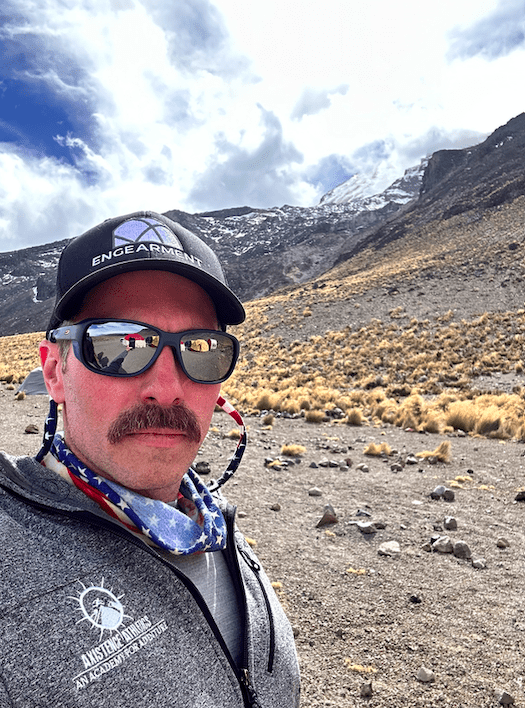
While the classic leather side panels of the “Vermont” style is what most folks think about when it comes to Glacier Glasses, in true Julbo spirit, the innovation continues with the Montebianco. The side shields are removable, but I kept mine on the entire time. Another side note, although these do have the Spectron 4 lens and they are rather mission specific, due to my eye sensitivity, I wore them every day while walking around the city and they were just fine. I wouldn’t wear them in the evening or for driving, but they were great for walking around.
The Montebiancos are light, with slightly curved and rubberized arms. One of my biggest concerns is a pair of sunglasses that fits too tight. If you’ve eve been above 14,000’ you know that swelling is a thing. I’ve had bad luck in the past with sunglasses that felt restrictive and ended up leading to headaches. The last thing you want is for the thing that’s supposed to be protecting you to cause you harm. That’s all to say that these things did not feel the least bit
restrictive. I wore them in the city with a hat on, and then on the mountain I wore them over my buff. Both worked great.
They do come with a small rubber cord that you can use to keep them around your neck but I opted for a red, white, and blue croakie strap because, you know, ‘Merica.
Depending on the options (Polarized, REACTIV, etc.), the Montebianco 2 can range from $99.95 to $229.95. Personally, if I’m going to drop over $200 on a pair of glasses, it’s going to be because of what they can do and not how they look. I’m sure Versace makes a cool pair of glasses, but if they won’t help me on my adventures, they’re not getting my money. With Julbo, you get what you pay for.
1. https://www.aao.org/eye-health/diseases/photokeratitis-snow-blindness
2. https://www.outsideonline.com/outdoor-adventure/exploration-survival/crystal-hunters-chamonix-mont-blanc-france/
Ryan Humphries
Growing up in southeast Missouri, Ryan spent most of his days playing in the woods, swimming in creeks, capturing wildlife, and dreaming of adventure. His asthma kept him from playing a lot of sports as a kid, but it didn’t stop him from achieving the ranks of both Eagle Scout and a Black Belt in Taekwondo by the age of 16.


Leave a Reply