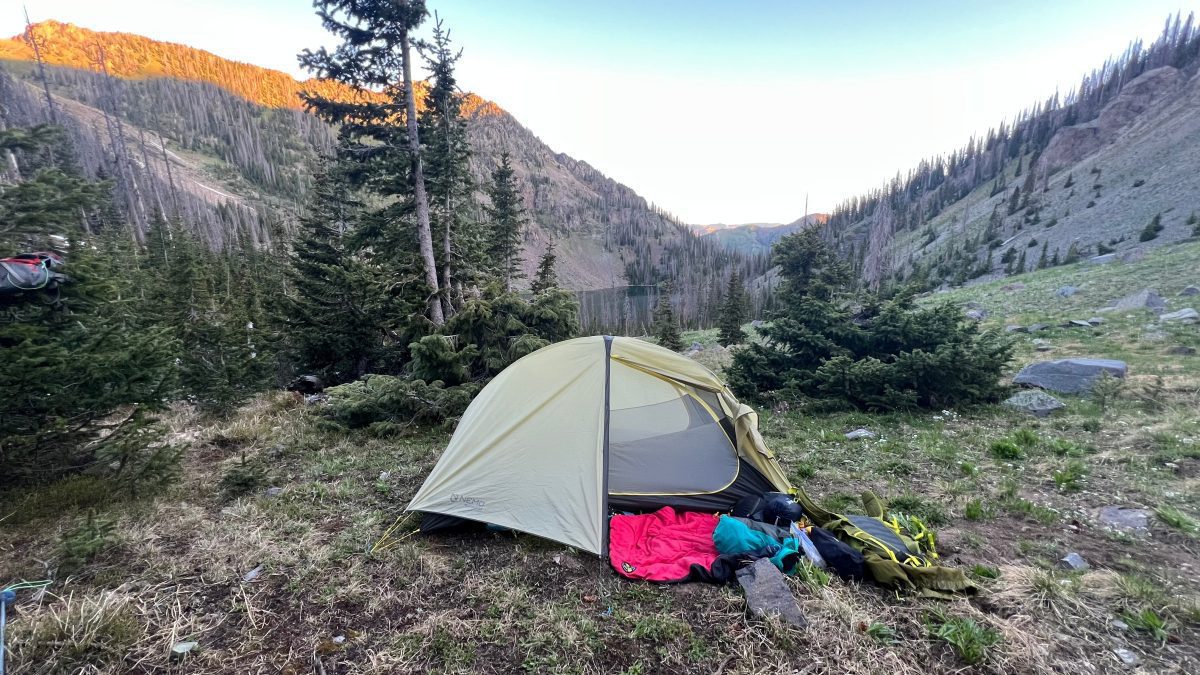
NEMO Hornet Osmo 2P
Review by Wil Rickards
Ultralight done right — if you can handle the intimacy
The Introduction
The package said it had come from NEMO. Standing in the mailroom, I turned it over in my hands, confused. It felt like a box of feathers. It wasn’t much bigger than a football. I checked the label again. As I walked outside, the clouds parted, sun rays illuminated the world around me, and I had a very clear sense of how this experience was going to unfold.
I was transported back to my first “lightweight” tent. A magnificent beast of nylon and aluminum that packed into a bag roughly the size of a border collie. I remember the salesman’s enthusiasm, the way he said lightweight with the conviction of a man who had never actually carried it uphill. My back disagreed, silently and persistently, for years. By the end of a long approach, the thing had rearranged my spine into something resembling a branch bowing under spring snow — curved, stressed, and quietly questioning every decision that had led it to this moment.
The NEMO Hornet Osmo 2P weighs just two and a half pounds. Let that settle. Two and a half pounds for a double-wall, semi-freestanding, two-door, two-vestibule shelter that does not require trekking poles, a theology degree, or a second person to pitch. The stuff sack is rectangular — genius — and drops neatly into the bottom of your pack rather than lashing to the outside like a barnacle of shame.

First Thoughts
I should confess that my first outing with the Hornet Osmo was not a gentle shakedown on a summer meadow. I was instructing a snow mountaineering class. NEMO will tell you, with perfectly reasonable justification, that this is a three-season tent. Not strictly speaking designed for snow. I am not, strictly speaking, someone who heeds those kinds of instructions before heading out.
So there I was, on a pitch that had no business hosting an ultralight backpacking tent, staking it with sticks as deadmen. If NEMO’s product team had been watching, they would have had opinions. Strong ones.
I am telling you this because of what happened next — or rather, what didn’t. The inside stayed dry. Completely. The bathtub floor, which climbs well up the sidewalls of the inner tent, managed to keep every trace of moisture on the outside where it belonged. On snow, with improvised anchors, in conditions the marketing department never envisioned, the Osmo fabric held its end of the bargain without complaint.

After a Lot of Nights and Some Great Backcountry Sleep
Let’s be direct. This tent has earned its place in my quiver, and it is not coming out. When I want to pitch a base camp and leave it standing while I explore an area, this is it.
The weight remains the headline act. Every time I hoist my pack and feel the absence of a tent that once bent me like a butcher’s hook, I experience a small, private joy.
The tripod pole system is efficient — lock the hub, run the poles out, clip them in, done. No fumbling, no cursing, no audience required.
It breathes exceptionally well. The mesh canopy and the clever cutaway at the head end of the fly create airflow that most tents at this weight class simply cannot match. Condensation, that old enemy of the backcountry sleeper, barely gets a look in. Top tip — know where the wind is coming from and pitch accordingly.

The Flybar — NEMO’s ceiling clip that lifts the fly away from the canopy — does exactly what it promises. More volume, less sag, better air movement. It is one of those details you stop noticing precisely because it keeps working.
The Osmo fabric is taut, sheds moisture with confidence, and the cut of the fly facilitates this beautifully — water has no excuse to linger. I have used this tent in conditions it was not designed for and conditions it was born for. It has not let me down once.
As a solo tent, it is a palace. Room to spread out, to think, to be a human being rather than a sardine — even with the dog, there is enough space. The floor is well-shaped and stays flat, making it easy to find everything, and if you do camp on a slope, it cradles a sliding mat, so you do not end up with your feet touching the fly. The walls taper; there is plenty of height to sit up. For two people, you actually will need to like each other. Not merely tolerate — lie on your back or happy to spoon like. That said, two doors are a lifesaver when you are squeezed in together. The ability to exit independently at night is less a convenience and more a means of preserving the relationship. It also gives the solo traveler options and plenty of room to spread their stuff out.

A Word on the Planet
NEMO has done the work here, not just ticked a box. The Osmo fabric is woven from 100% recycled nylon and polyester yarns, and the entire tent is PFAS-free — no forever chemicals in the coating, no flame retardants added through harmful processes. For those of us who choose to spend our lives in wild places, this is not a small thing. The mountains we sleep in deserve better than the residue of the gear we use to sleep in them. It is encouraging to see a manufacturer treat sustainability as an engineering challenge rather than a marketing footnote. NEMO has, and the Hornet Osmo is a better tent for it.
Put simply, if you are looking for a lightweight, semi-freestanding tent that delivers beyond expectations, I give the NEMO Hornet Osmo 2P two thumbs up. It is worth checking it out.
Wil Rickards
 Wil was born in North Wales and steeped in its rich maritime, mountain and river folklore. In response to the request to “get a real job” he became first a teacher then professor of adventure education.


He then emigrated to where the sun shines for 300 days and snowfalls for 100 (Colorado). During more than 25 years as an outdoor educator, he worked Scottish winter seasons, taught canoeing, climbing, kayaking, and skiing throughout the States, Europe, and Australia. He also regenerated the University of Alaska Anchorage’s Outdoor Education program. His biggest adventure (by far) is fatherhood. It has also been the inspiration for his website www.wherethefruitis.com.


Things he likes to do include (middle) aging gracefully, and skiing (telemark) aggressively. He is happiest outdoors with a good view, good company, good weather/snow and the residue of self-powered adventure; sweat, a manic grin, and wild eyes. 


Leave a Reply