
Drew Thayer
Moving fast to chase ski conditions in the backcountry is easy and comfortable with Patagonia’s clothing layers.
There aren’t many joys greater than a successful ski tour in the backcountry. What makes this pursuit so compelling? There’s the satisfaction of having followed the forecast and read it right: the weather, the conditions, the timing. There’s the vigorous exercise outside, the liveliness of moving, the cold air on your face. Of course, there’s the skiing, which is hopefully even better since the turns are hard-earned. But if you’re addicted to the backcountry, it has to be about more than downhill turns.
For many of us, backcountry skiing is about the joy of unencumbered motion in the wild expanse of winter landscapes. The magic we feel, no doubt, is born from the bold contrasts of the setting itself: pristine, yet harsh – at times cold, windy, glaring, even hot – to be out there and to move comfortably and confidently in conditions we can barely survive in is much of the joy itself.

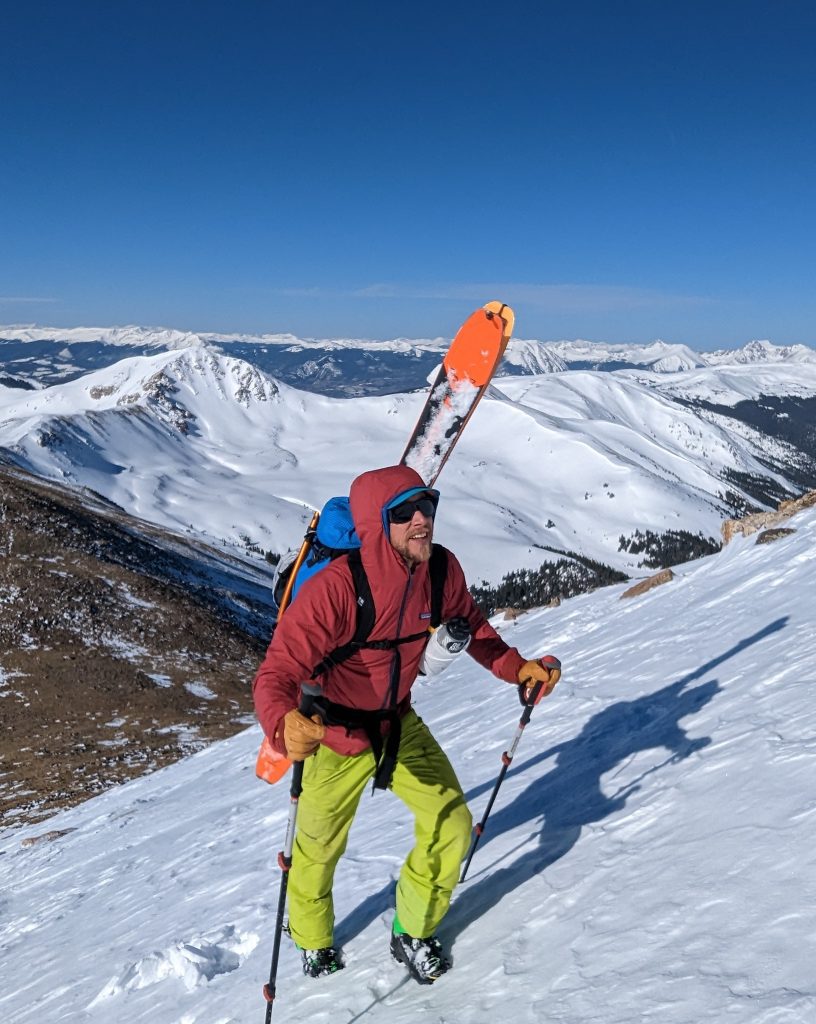
When chasing corn-o-clock on the continental divide every minute matters. The Patagonia Nano-Air Light Hybrid Hoody excels at the transitions above the treeline from sheltered faces to wind-swept ridges. The tight weave on the panels and hood blocks enough wind that I can just zip the hood tight and avoid a layer change, staying focused on booting to the summit.
Picture the broad range of extremes we experience during a typical mid-winter ski tour. Step out of a hot car into sub-freezing, blowing snow. Jackets on, flash-freeze hands while stretching the skins on, fumble with beacons and zippers. 15 minutes later, moving fast uphill through a snow-draped forest, no wind, heat builds in the still air and the legs work. Strip off layers; clothing gets wet with sweat. Forty minutes later, emerge from the treeline, moving steady and stripped to base layers. Wind hits like a wall. Exposed flesh instantly freezes, but the body is still hot and sweating. Bundle, hoods on, bigger gloves, cover skin. Steady work up a ridge. Under the wind shadow, too hot in the parka. Kick steps to the ridge and feel the brunt of the wind, all layers on, buff, goggles, cover it all. Drop on the leeward side to transition, suddenly calm. Thick snow, jump turns build heat, strip to shred, whoop it up. What a whirlwind, what we love.
While I could technically enjoy exploring the mountains in just about any clothes that are warm enough, in such harsh and variable conditions as we frequently encounter in the backcountry, poorly designed clothes can really detract from the experience. I’m out there to move and blend into the larger expanse around me, not endlessly fiddle with zippers, wet clothes, cold fingers, and sweat-soaked layers that freeze in the wind. Testing the Patagonia ski line over the past few years has let me hone a clothing system that stays out of the way and lets me simply move across the snow, focused on motion in the landscape instead of managing my personal needs.
Insulation while skinning:
Patagonia Nano-Air Light Hybrid Hoody

After trying a whole lot of baselayer – fleece – light jacket combos over the years I knew that the Light Hybrid Hoody from the Nano Air line would be the one the first time I took it out. Patagonia changed moving insulation 10 years ago when they released the original Nano Air jacket – essentially the first light puffy on the market that felt warm but breathed well. This piece instantly became a favorite amongst alpinists, ice climbers, and skiers, but was really designed for movement in truly cold environments with 60 gram synthetic sheets of insulation across the whole torso, arms, and hood. I wore my original Nano Air to death on mountain excursions, but I always found it a bit too warm for ski touring unless it was really really cold.
About 5 years later Patagonia released an updated version with 40 gram insulation that was more suitable for the majority of people moving around in winter but not necessarily climbing a frigid mountain. This is a great piece and became even more popular. During the same few years around 2019-2020 they started diversifying the R1 line as well, releasing an R1 Air made of a zig-zag-waffle-like fleece that created more dead air space than the classic R1 material and is thus warmer, but doesn’t block any wind. Then in 2020 they combined these fabrics into a midlayer perfect for backcountry skiing: 40 gram Nano Air insulation on the chest, hood, and outer arms to provide breathable warmth that blocks a bit of wind, with R1 Air ziggy-waffle fleece under the arms and across the back to dump as much heat as possible and keep the sweat factor lower against a backpack.
The Light Hybrid Hoody does the best job of keeping my temperature relatively stable across the ranges of cold, wind, and physical exertion encountered skiing. The extra-breathable paneling under the arms and against my backpack is genius, and the 40 gram insulation works perfectly over a light wool baselayer once I’m moving on the skin track. I only wear additional insulation if I’m on a casual tour moving slowly, or if it’s single digits and I’m exposed to wind. In spring, the face fabric on this piece is tight enough and blocks enough wind that I’ll often ski runs wearing it and not bother donning a windbreaker, making layering really simple. If I could change one thing, I wish they fitted the zipped hoody version with a chest pocket instead of low side pockets, since I’m usually wearing a waist belt and a chest pocket is more useful for holding a phone and a snack. Other than that, this is an all-time favorite piece for me and I wear it on pretty much every tour from December to May.
Additional insulation for frigid temps and overnight tours: Patagonia R1 Thermal Full-zip Hoody

The venerable R1 fleece hoody has been my go-to mid-layer for cold pursuits for years – essentially every climber owns one. While the classic R1 will always be the favorite do-anything layer for climbing and alpinism, Patagonia’s newer variations to this line are more useful for ski touring in my opinion. While the classic R1 with its long hem and raised-block waffle fleece is really optimized for stop-start activity while wearing a harness, the new variants offer better breathability in the R1 Air or more warmth and wind-blocking in the newest addition, the R1 Thermal Hoody. A lot of skiers like the R1 Air for good reason, but I find it works best hybridized with the Nano Air as the Light Hybrid Hoody as discussed above. For me, the new Thermal hoody is the best mid-layer piece for tours where I need additional mid-layer warmth: very cold winter mornings or multi-day tours.
R1 Thermal Full-zip Hoody is a fairly close cousin to the classic R1 half-zip pullover hoody, with a few subtle differences that make it my preferred choice for winter layering. First, it’s warmer, with a tighter micro-grid fleece that’s thicker and denser than the raised-block classic fabric. This new fabric is also a tighter weave on the outside, which blocks a bit of wind, snow flurry, or the inevitable dump of snow released from a weighted bough while skinning in a dense forest. The fabric alone makes it a better choice for ski touring because it works better as the outer layer worn while skinning while it’s cold, which is typically how you’ll be wearing it.
A few more subtleties make this a great touring mid-layer. It only has two chest pockets and no hip pockets, which makes sense while wearing a pack. The hem is a bit shorter than the classic, which is fine because you’re not wearing a harness, and the arms are quite long which helps keep the hands warm as they protrude from larger jackets. Other than that, you get the classic athletic fit that’s easy to layer over, and a hood that clings tight to your head and ears and fits easily under a helmet. Folks may quibble about the full-length zipper. I like the half zipper on the classic R1 for climbing because it keeps a zipper out of the bunched-up material under my harness and changing clothes while dangling at a belay is a delicate matter anyhow so pulling the piece over my head is hardly an inconvenience. For skiing, where we are transitioning frequently and quickly through the duration of a tour, I welcome the full zip and don’t mind the extra zipper.

The R1 Thermal full-zip hoody makes an ideal second layer above a wool baselayer. Comfortable and warm, with a tight fitting hood and long arms that keep tight to glove cuffs, it also sports dual chest pockets which are easily accessible while wearing a pack.
This warmer mid-layer comes with a slight weight penalty (15.3 oz up from 11 oz in the classic men’s medium) that’s totally worth it for me. On cold winter tours where the mornings are below 10 degrees or on multi-day tours when I’m camping in a yurt or a tent, the R1 Thermal Hoody rounds out my layering system.
Hard-shell pants for all conditions:
Patagonia Storm Stride Pants

I was fully committed to soft-shell ski pants until I tested the Storm Stride pants. My past experiences with touring in hard-shell pants had always been disappointing – waterproof pants are either lightweight and feel like swishy trash bags or cumbersome rigs replete with extra pockets and heavy-duty fabrics that feel more appropriate for riding chair lifts. The Storm Stride pants are a refreshing option for backcountry skiers who like to move because they keep the wet and wind out while remaining very breathable, with exceptional range of motion.
These pants are built simply with the touring enthusiast in mind. with only the minimal features required to support touring. The ankles have an elastic snow cuff and short zipper with snaps in a few positions to accommodate different boot sizes. While these features are standard on most snow pants, the important thing is that they are done well: the cuff is not too tight and the ankle is wide enough to pull over voluminous ski boots. You get just the two pockets that skiers need: zippered cargo pockets on the thighs in just the right place for carrying their contents seamlessly through the skinning stride. I keep my phone in the right pocket and my beacon in the left – phone snug in a coozie when it’s below 10 degrees. Above that you get belt loops and two elastic tabs to cinch the waistband – personally I just wear a belt. The last piece are venting zips on the lateral hamstring. This is a small detail, but I like that the zipper opens down instead of up – easier to unzip without breaking stride as the body warms on the uptrack.
That’s it – no fancy additions, the magic of these pants is all in the fabric and the details of the cut: a slight articulation and pre-bend that accommodates the knees through the full range of flexion (dropping into dem face shots) while cut roomy enough to allow for full extension as you pop into the next turn.
As for fabric, the Storm Stride pants are made of a 3-layer stretch material with Patagonia’s H2No membrane. They don’t stretch as much as jeans, but unlike most hard-shell pants they do stretch, which allows for the end-range motions we find ourselves performing on ski tours: wide kick turns on the skin track, laying in a boot pack, straddling over logs (unfortunately…). The H2No membrane is truly waterproof, which is nice for spring in the Rockies, overnight trips, and all season for the PNW folks.
The breathability of these pants is the clincher that made them replace my softshells as my go-to pants. While I always feared the dreaded clammy legs from hardshells, I find myself touring in these in temps above freezing, and even in the sun without discomfort. The open leg vents dump a lot of heat, and paired with thin leggings these pants are even comfortable in spring. Simple and effective, the only pants a touring enthusiast needs.
Drew Thayer


Leave a Reply