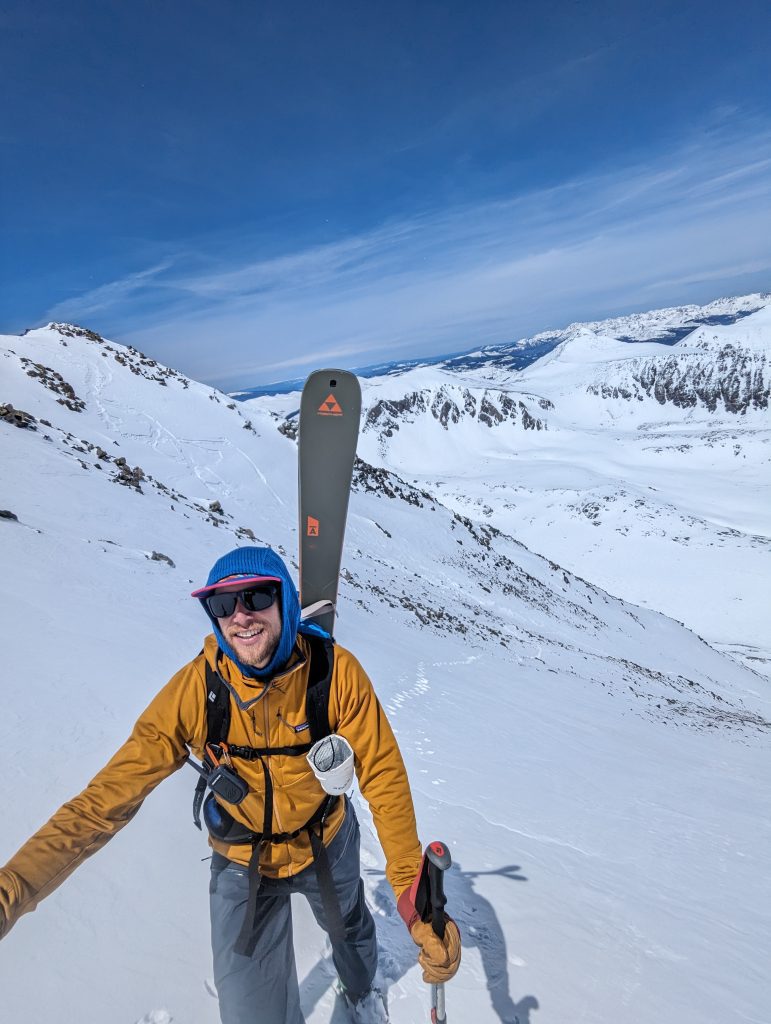
Drew Thayer
Fischer Transalp 98 CTI
Power and precision in a 1500 g touring ski
“It’s like having two f*** leopards strapped to your feet!” – first text message I sent to Sean Sewell after my first tour on the Fischer Transalp 98 CTI.
Colorado Front Range winters are a little bizarre for a skier, but the ski season is long. Really, there are 3 ski seasons. In early winter we ski facets in the trees, avoiding open terrain, but in early March something magical starts happening… coverage improves, the near-surface facets become a bit more buried, and folks start opening it up a bit – with an abundance of caution. I have my little spots.
One such afternoon, after just receiving the Transalp 98 CTI skis in the mail and mounting them in the garage, I took them out to a little spot where one can get a decent 600’ of steep fall line. The snow was perfect mid-season cream – “cream cheese” I call it, just a touch packed by the wind and settled by a hint of warmth into smooth smooth butter smooth cream. I usually ski this terrain in a couple pitches.
I ripped skins and dropped into the fall line, and WHOOSH – I’m falling into the line, instantlypected picking up more speed than I ex. Each turn is deep, powerful, I get ready for a big compression but the skis do the work, absorb the turn and spring me out, almost leaping for their next bite.
Whoosh, whoosh, these skis are hell-bent on carving the slope and I’m just holding onto the reins, in control but amazed at sheer velocity of the ride as they fly into steeper turns with a hunger for each bend. I can feel their appetite through my boots, it’s scary but exhilarating. In a flash I’m at the valley bottom, panting, wondering what just happened.
Forget riding the slope, I was just taken for a ride – and I needed more. Now. I didn’t even stop for a snack, whipped a fast transition and began cutting track up the 900’ valley wall for round 2. Then 3.

Not your grandma’s lightweight mid-fat touring ski
Mid-fat skis are all the rage in the Rockies, for good reason. Most folks in a continental snowpack can pretty much ski a 95-105 mm waist the whole season and get by – I did for years when I could only afford one pair of skis. Throw in a soft tail, a slight camber, and a bit of early rise, with some wood in the core to dampen things a bit, and a mid-fat ski can handle pretty well in powder, thick chunk, windboard (dare I say), and of course the corn.
Skis in this category that come to mind: Dynafit Free/ Sphinx 97 and 105, Black Crowes Camox 95 and Navis 102, Atomic Backland 95 and 102, and perhaps Blizzard Zero G 95. Such skis are often described as “playful”, “forgiving”, and/or “all mountain”, and a great choice for heading out on large tours where a variety of snow conditions is expected, or you don’t know what to expect (i.e. Spring in the Rockies).
The Transalp 98 CTI is something different. These puppies charge.
Forget quiver-of-one, reach for the scalpel
Manufacturers love to push the “quiver of one” narrative, which is mostly BS. As if all us ski nerds who actually read these reviews own only one pair of skis. We dream. We scheme. We obsess. We build a quiver of tools specific to their purpose, and this ski is for people who want to charge fast in consistent snow.
I’m exaggerating, but stepping out on larger fall lines in late-winter conditions on these skis I almost had to learn how to ski again. Compared to the mushy powder skis I’ve been tooling around with during the middle of winter, snagging stashes in forest glades, these skis simply wouldn’t stand for passive side-slip drifting through powder or the languid pop-and-pivot through the fluff stuff. Forget about bounce, play (every ski is described “playful” these days…), these want – DEMAND – to be driven. They want to be skid directionally, and they respond instantaneously with precision and power once you point them and engage.
Imagine a ski that can bend GS turns but only weighs 1560 grams (at 183 cm length)… I didn’t think such a thing could exist, but I’m a believer now. Quite simply, the Transalp 98 CTI just wants to charge and charge fast. They are stiff enough to absorb a ton of load into each turn, and respond with a smooth but potent rebound. The paulownia wood core is largely responsible for this damp, directional performance, and provides a structure that doesn’t chatter – impressive for the light weight. The tails are also quite supportive, which encourage these skis to take the faster, carvier path out of each turn and keep stability high at speed.
Entering a steep fall line in these skis is truly an experience. They just want to devour the terrain, as fast as you’ll let them. Or faster.

Corn just ripened on the continental divide, ready to drop. These skis eat up corn in all its temperature variants, particularly on the colder side where the bite and spring provides a spirited ride. However if the slope is a bit over-cooked there is just enough flex to get surfy and throw the rooster tail around.
Trade Offs
No specialized piece of gear is without its trade-offs. My overall experience is that the Transalp 98 CTI provides a rowdy and spirited ride in consistent snow, far outshining the performance of softer mid-fat skis, and this comes at the cost of being a bit unwieldy in variable snow.
These skis are not very forgiving. That supportive tail in real-talk means a tail that grabs a bit more than you’d like when busting through wind-board. Breakable crust is truly quite hard to ski (but is it ever fun?). De-tuning the last 25 cm of edge was mandatory for me to be able to make it safely through the low-elevation funk on spring tours. While stiffer skis certainly exist (Black Crowes Orb 88, Fisher Hannibal 96) The Transalp 98 should be considered on the racier, more powerful side for its mid-98 lightweight touring class.
Spring skiing dream
These skis really shine in the 3rd Colorado ski season: pow and corn in April and May. If you’ve been skiing corn with wide, soft planks or narrow, chattery skimo gizmos, strapping these on your feet will really change your corn game. I never really felt like I was embracing speed on just-warmed high altitude slopes, really leaning into it and wanting more, until skiing the spring corn cycles on the Transalp 98 this spring.
For those longed-for late spring pow days, the broad nose and large surface area of these skis provide enough flotation to have fun, especially since the powder skiing in spring tends to be steeper.

Who is this ski for?
This should not be your only backcountry ski. The Transalp 98 CTI belongs in a quiver (the quiver is not dead!) of an athletic touring enthusiast who likes to go higher and further on steep, open terrain. If you’re nodding your head, you already know this about yourself. In the Rockies, this ski will bring out extra delight on steep terrain in spring, perhaps making known terrain more lively with a faster, snappier ride, perhaps opening up new terrain as you tour further with 1500 gram skis. In the Cascades these skis will excel on volcanoes with their precision, power, light weight, and mid-fat waist. Across the western US this ski will almost surely add some spunk to your corn harvest if you’ve been used to skiing softer mid-fat skis, just be ready for them to bite into what you drop into.
Tech specs
Transalp 98 CTI comes in 4 lengths
- 162 cm, 1250g
- 169 cm, 1360g
- 176 cm, 1390g
- 183 cm, 1560g
Drew Thayer


Leave a Reply