
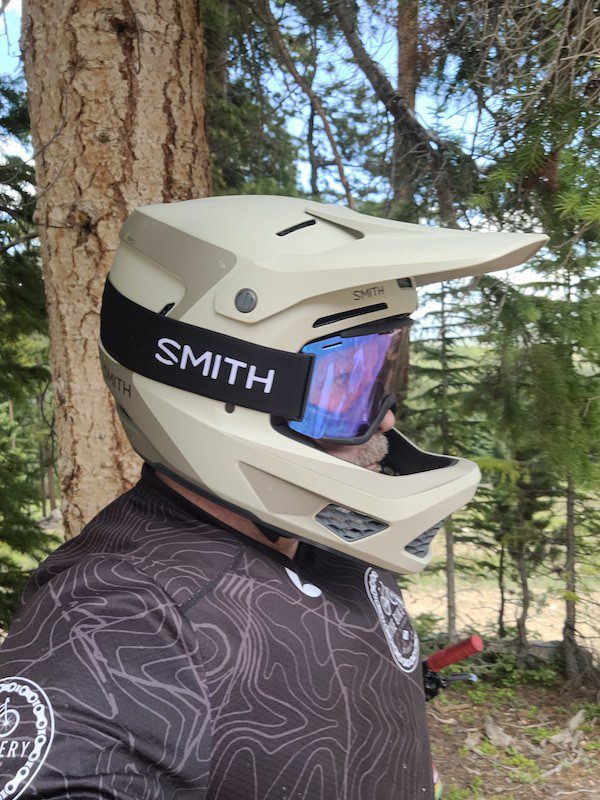
Smith Hardline Composite Downhill Helmet
Review by Will Trail
Initial Impressions
The Smith Hardline Composite Downhill Helmet is a full-face, downhill-oriented helmet that combines premium safety features, rider-focused comfort, and seamless goggle integration—all wrapped in a sleek, lightweight package. Constructed from a fiberglass composite shell, the Hardline is engineered for aggressive riding and downhill racing, meeting EN 1078, CPSC, AS/NZS2063, and ASTM F1952 certification standards.
I reviewed the Smith Hardline Composite Downhill Helmet in the Matte Chalk colorway, and it has been my exclusive bike park helmet this year.

Protection First
Smith has equipped the Hardline Composite Downhill Helmet with a full suite of protective technologies. KOROYD® crumple zones line the helmet to absorb direct impacts, while the Mips® Safety System helps mitigate rotational forces during crashes. For added peace of mind, the helmet features a collarbone impact zone at the bottom edge to reduce the risk of secondary injuries.
The breakaway visor is designed to detach on impact, reducing neck strain, while quick-release cheek pads allow first responders to remove the helmet more easily in emergencies. A secure D-ring chin strap provides a snug fit and operates just like other D-ring systems.
Comfort & Fit
Inside, the Smith Hardline Composite Downhill Helmet features a breathable Ionic+® anti-bacterial liner that helps manage moisture and odor. Smith includes multiple liner and cheek pad sets to fine-tune the fit. The adjustable visor and wide front opening integrate cleanly with goggles, and there’s an action camera mount tucked beneath the visor for POV footage. I have not noticed any squeaking from the internal frame that cradles the head, in fact this a very quiet helmet all around.
Despite being a full-face helmet with DH certification, the fiberglass version weighs in at 990 grams. While it’s heavier than a half-shell or enduro-focused helmet, I never experienced neck strain during use. Using Smith’s online size chart, I chose a size large, and it fits well—no bouncing or excessive twisting. I didn’t need to swap out the cheek pads or neck rolls; the standard fit worked perfectly for me.

Ventilation & Integration
The Smith Hardline Composite Downhill Helmet features Smith’s AirEvac ventilation system, which is designed to integrate seamlessly with their goggles and reduce fogging. Venting includes a large chin bar opening, brow vents, and rear exhaust channels to promote airflow during high-output rides.
I’ve been using the Smith Squad XL MTB goggles with this helmet, and they integrate seamlessly and vent well. The Hardline is clearly built for downhill use and, as such, trades a bit of airflow for added protection. I’m a heavy sweater, and while I did notice some sweat buildup around my ears, it never distracted from the ride.

Closing Thoughts
The Smith Hardline Composite Downhill Helmet isn’t the lightest or most breathable helmet on the market, but it excels in safety, fit customization, and goggle compatibility. It’s a premium helmet that delivers real value through thoughtful features and rugged construction. Fortunately, I haven’t had to test its crash-worthiness—but I’m confident it would perform admirably in that scenario.
I never thought I’d like a “plain white” helmet, but the Matte Chalk colorway has really grown on me. The styling is sleek and modern without looking out of place.
Pros
- KOROYD® crumple zones for blunt impact absorption
- Mips® Safety System to mitigate rotational forces
- Open frame allows front-to-back airflow and breathability
- Includes two washable cheek pad kits, crown liners, and neck rolls for fine-tuning fit
- Ionic+® anti-bacterial performance lining for odor resistance
Cons
- Downhill-focused construction limits airflow slightly
Bottom Line
If you’re seeking top-tier protection that looks sleek and modern, the Smith Hardline Composite Downhill Helmet is a standout option for downhill riders and gravity athletes alike.
Will Trail
Will grew up in Idaho (fifth generation!) where he enjoyed the outdoors, riding his bike, participated in multiple sports, and working on the family ranch from time to time.

During college at Montana Tech, he played football for a few years and worked as a wildland firefighter during the summers. He met his future wife, Erin Trail, there and after graduating with a degree in Geophysical Engineering, they moved to Texas where he was involved with racing his Subaru WRX, camping and powerlifting.



Leave a Reply